
Signed monorepo releases using GitHub Workflows

The nice thing about personal projects is that you only have to convince yourself. When you get an itch, you scratch it.
Last weekend’s itch was the dotsecenv release pipeline. Specifically: 150 lines of shell on every release that did GPG dances on a GitHub Actions runner just to sign a single commit into a satellite repo. It worked. It also looked nothing like code I wanted to maintain.
The rewrite ended up at zero private keys on the runner, one GraphQL mutation, and a custom GitHub Action we can reuse across the whole org. Here is what got in the way.
Why dotsecenv needs satellite repos
Section titled “Why dotsecenv needs satellite repos”The dotsecenv project sits in a mostly monorepo structure. “Mostly” because Homebrew and GitHub Pages each need their own repo:
- homebrew-tap, because Homebrew expects a tap to live in its own repo at
<owner>/homebrew-<name>. - packages, because GitHub Pages publishes one site per repo. The main site is on dotsecenv.com, so the Linux and Mac package indices for apt, yum, and arch need their own GitHub Pages host.
Then there is the shell plugin repo. Plugin managers like oh-my-zsh and fish clone single repos. Package indexers like apt and yum do the same. None of them can fetch a subdirectory of a monorepo. So the plugin lives in its own repo, and the release pipeline pushes into it on every tag.
The pattern is the same for all three satellites: take the source-of-truth output (formula, package index, plugin code), write it into a satellite repo, sign the commit, push.
What the first version looked like
Section titled “What the first version looked like”The first version was a shell script. It generated a signing key, imported it on the runner, configured git config user.signingkey, ran git commit -S, then git push. The script also handled cleanup, key lifecycle, and a handful of corner cases that surfaced after the first few releases.
By the time it was reliable, it was about 150 lines. The signing key had to be a real secret with real lifecycle. We had to trust the runner with that secret for the duration of the job. Every new satellite repo meant another copy of the same shell to maintain.
A cleaner shape was waiting: have GitHub sign the commits itself, attributed to a GitHub App, with no private key on the runner at any point. GitHub exposes exactly that via the createCommitOnBranch GraphQL mutation. GitHub signs each commit with its own key, so it lands as a Verified commit in the satellite repo.
Sounds great. The mutation is also where I lost most of two days.
gh api -F lies about your JSON types
Section titled “gh api -F lies about your JSON types”The natural way to call a GraphQL mutation from a shell script is gh api graphql -F input=@file.json, where file.json is your variables payload.
The -F flag has a footnote in the gh docs: it reads scalars and auto-detects type. The footnote does not mention that when you pass @file.json, gh reads the file as a single string and only auto-detects type at the top level, not inside the file. gh then silently sends every boolean and integer inside that file as a string.
The createCommitOnBranch input schema has typed fields. Send one of those as a string when the schema expects a structured object and GitHub rejects the whole call:
invalid value for type CreateCommitOnBranchInput!The error message names the top-level input type, not the field that is actually wrong. Which makes the bug delightful to track down on a release-blocking workflow.
The workaround is straightforward once you find it. Build the request body yourself with jq --slurpfile so the types survive, then feed the resulting JSON as a single raw payload via --input -. That worked. It also added enough boilerplate that the script kept growing. The version that finally shipped was about 150 lines of shell and a mess to read.
Extracting the custom GHA
Section titled “Extracting the custom GHA”A 150-line shell script that solves a recurring problem deserves to be its own artifact, not buried inside a release workflow. Other projects shipping to satellite repos hit the same Verified-commit / no-key-on-runner constraint and the same gh api stringification footgun.
I extracted the working version into releasetools/actions/signed-push, a custom GitHub Action. The action takes a source directory, a target repo, a target branch, a commit body, and a token. It writes the directory into the satellite repo via createCommitOnBranch and tags the commit. The caller never sees GraphQL.
The commit body uses RFC-822 trailers so the linkage to the source commit is both human-readable and machine-parseable:
publish: v0.6.1
Source-Commit: dotsecenv/dotsecenv@21eee0028a7b8182e37cac526725b2fa9023d6e4Source-SHA: 21eee0028a7b8182e37cac526725b2fa9023d6e4Source-Path: packagesSource-Tag: v0.6.1Published-By: https://github.com/dotsecenv/dotsecenv/actions/runs/26005850942
Source-Commit in owner/repo@SHA form gets auto-linked in the GitHub commit view, so the satellite commit always points back to the monorepo revision that produced it. Source-SHA, Source-Path, and Source-Tag are denormalized into separate trailers so downstream tooling can grep them out without parsing the compound form.
When this pattern is worth it
Section titled “When this pattern is worth it”The signed-push pattern fits when all of these are true:
- You publish to one or more satellite repos on every release.
- You want commits in those repos to be signed and verifiable on GitHub.
- You do not want to manage a long-lived signing key on a CI runner.
- The satellite repos are within or accessible to a GitHub App you control.
If your release flow already runs git commit -S with a hardware-backed key on a self-hosted runner you control, this rewrite buys you nothing. If you are doing key generation, GPG import, and key cleanup on hosted runners across multiple satellite repos, it deletes a lot of code and a lot of lifecycle complexity.
The end state runs in a single workflow: unified release view. Goreleaser builds the binaries. Homebrew-tap, packages, and plugin satellites each get a signed commit and a tag. Zero private keys touch the runner.
And every release renders as one DAG you can read at a glance.
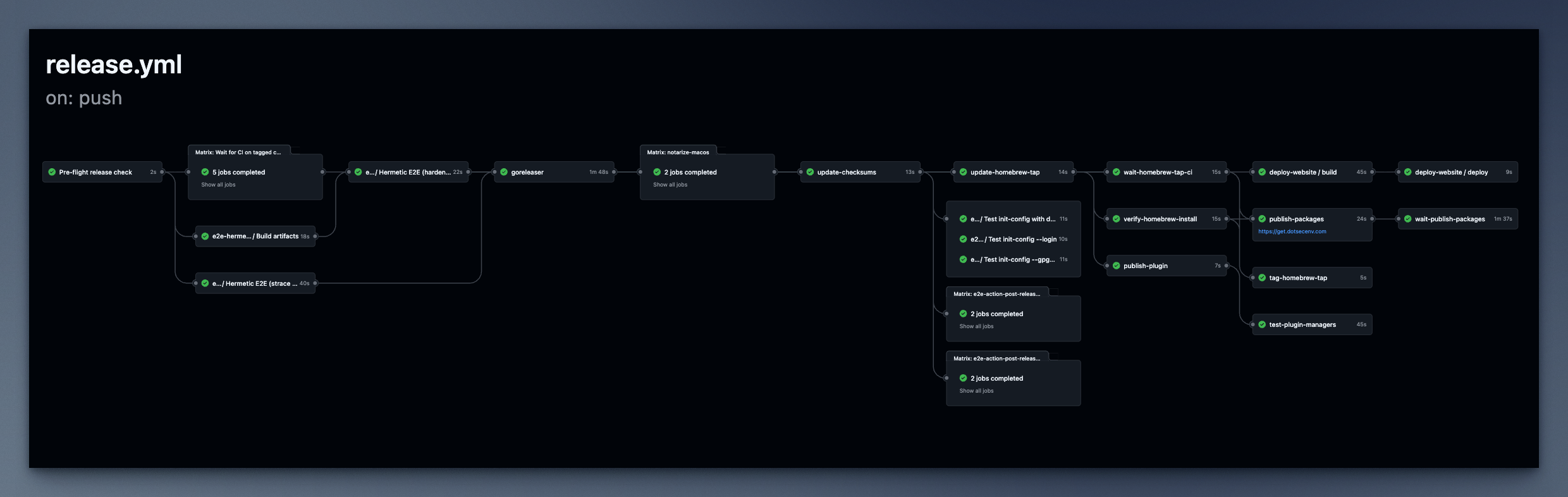
Green across the board means the release shipped, end to end. A red box anywhere shows you exactly which step to open, no clicking through CI dashboards on three other repos.
The custom GHA is open source: releasetools/actions/signed-push. The dotsecenv migration that adopted it is in commit 17b003e, with the earlier groundwork in commit 21eee00.